Fibre Cement Board Cladding
Finding Inspiration in Every Turn
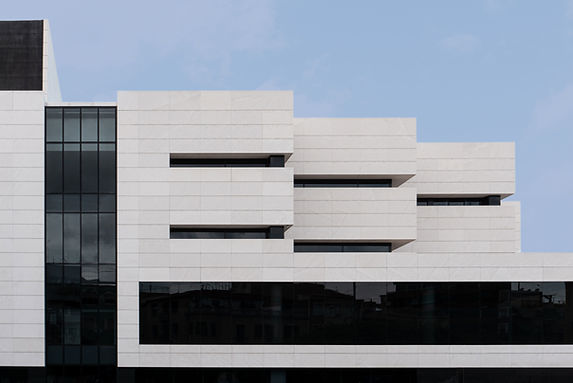
Fibre cement is a composite of sand, cement, and cellulose fibres. It is one of the most versatile and widely used cladding materials.
Design & Installation
Fibre cement boards are installed as part of a ventilated rainscreen system. Boards are fixed to timber or metal battens, with a minimum 15–20 mm drained and well-ventilated cavity behind them. Battens are typically spaced at 600 mm centres. Boards can be installed horizontally or vertically and are available in lengths of 3000 mm and 4200 mm. The interlocking edges allow for quick installation with concealed fixing.
Performance & Sustainability
Fibre cement is highly weather-resistant, dimensionally stable, and offers excellent fire performance. It is available in a wide range of textures and finishes—from smooth and fine-textured to wood-grain and brick-effect. Boards can be pre-sealed and painted in any colour.
Fibre cement's sustainability profile is highly variable and depends heavily on cement content and manufacturing energy. Its Global Warming Potential ranges from 0.53 to 1.83 kgCO₂e per kg, with cement content being the primary driver of variation. This is a significant impact, as cement production is a major source of industrial CO₂. On the positive side, fibre cement is 100% recyclable and holds Cradle to Cradle Certified Bronze in some product lines. Its durability exceeding 50 years and lightweight nature (reducing transport emissions) are further advantages. The key to a sustainable fibre cement specification is to prioritise products with lower cement content, verified EPDs, and Cradle to Cradle certification.
Key Considerations
-
Cavity depth: A minimum 20 mm ventilation cavity is mandatory for most systems to ensure effective drainage and drying.
-
Cutting: Fibre cement generates dust when cut; appropriate PPE and dust extraction are required.
-
Best suited for: A broad range of residential and commercial projects where cost-effectiveness, design flexibility, and proven performance are key.